Head table or sweetheart table: who sits where
A head table seats the couple and their wedding party in one row facing the guests. A sweetheart table seats just the two of you. A third option is no special table at all. Here is how to choose, who usually sits at a head table in the US, and how long it needs to be.
Free to use, no account needed. Your guest list stays in your browser.
Head table vs sweetheart table vs no head table
Head table
A long table for the couple and wedding party, facing the room. Everyone can see you, and your closest people are beside you. The catch: partners and plus-ones of the wedding party need a seat too, and a big party means a very long table.
Sweetheart table
A table for two. It is easy to set up, gives you a quiet moment, and lets the wedding party sit with their dates. Some couples find it feels a little isolated, so seat people you love at the tables closest to you.
Kings table
One long table with guests on both sides and the couple in the middle, often used for family-style meals. Everyone at it can talk to each other, but half of the seats face away from the room.
No head table
You sit at a normal round table with friends or family. It is the most relaxed option and needs no extra furniture. Tell your venue and your DJ or toast givers where you will be, so the microphone and toasts still work.
There is no right choice. A head table suits a big wedding party and a formal feel. A sweetheart table suits couples who want a calm moment or whose wedding party is mostly in couples. In the UK, the same table is called the top table, see who sits at the top table.
Who sits at the head table
Common US practice, which varies by region, family and venue: the couple sit in the center. The maid or matron of honor sits next to the bride and the best man next to the groom, then the bridesmaids and groomsmen alternate outwards. Some couples add the officiant, or put the parents at the table. Treat this as a starting point, not a rule.
- Spouses and plus-ones. Many couples do not seat the wedding party’s partners at the head table, because it would double its length. They then sit together at a table right beside it. If you want everyone at the head table, expect a very long row or a table with seats on both sides.
- Parents. A frequent choice is a table of their own near the head table, with grandparents and close relatives. This keeps the head table short and lets the parents sit with their own partners.
- Divorced or blended families. Give each parent a table of equal standing near you, so nobody is ranked or seated beside someone they would rather avoid. Talk to them beforehand.
- Flower girls and ring bearers. Young children usually sit with their parents, since a long dinner is hard for them at a head table.
- Fewer people is easier. A head table of six to eight feels intimate. If your wedding party is bigger, split it across two tables placed side by side.
Layouts and sizes
Rule of thumb (an estimate, check with your venue): allow about 2 feet of table length per person, and more if you want flowers or candles in front. So an 8 ft banquet table fits about four people along one side, a 6 ft table about three. Two 8 ft tables end to end seat about eight. For round and banquet table sizes, see how many guests per table.
Seats on one side
Everyone faces the room, nobody has their back to the guests. This is the classic layout. Leave a gap behind the table for servers.
Seats on both sides
Takes up less room width, and the couple sit in the middle of one side. People on the other side face the couple, with their backs to the room.
Round table at the front
A large round table is more social, but some seats face away from the guests. Many couples leave those seats empty.
Two tables, an L or a T
Works when the wedding party is large or the room is narrow. Check that guests can still see the couple.
Put the head table where the whole room sees it, usually opposite the entrance or in front of the dance floor, and not in front of a window with bright light behind you. Check where the toast givers will stand, and whether the couple can get out without climbing over anyone.
Decor tips
- One long garland or a low flower runner looks full from across the room and keeps sightlines open. Tall centerpieces block the view of the couple.
- Match, but do not need to copy, the guest tables. The head table can use the same linens and colors with a bit more florals or candles.
- A backdrop such as drapery, greenery or a sign behind the table gives photos a focal point.
- Add a table name or card. Some couples label it “Head table” or the couple’s names. See table name ideas.
- Place cards for everyone. Even a small head table looks neater with a printable place card at each seat.
How to plan the head table in Seating Solver
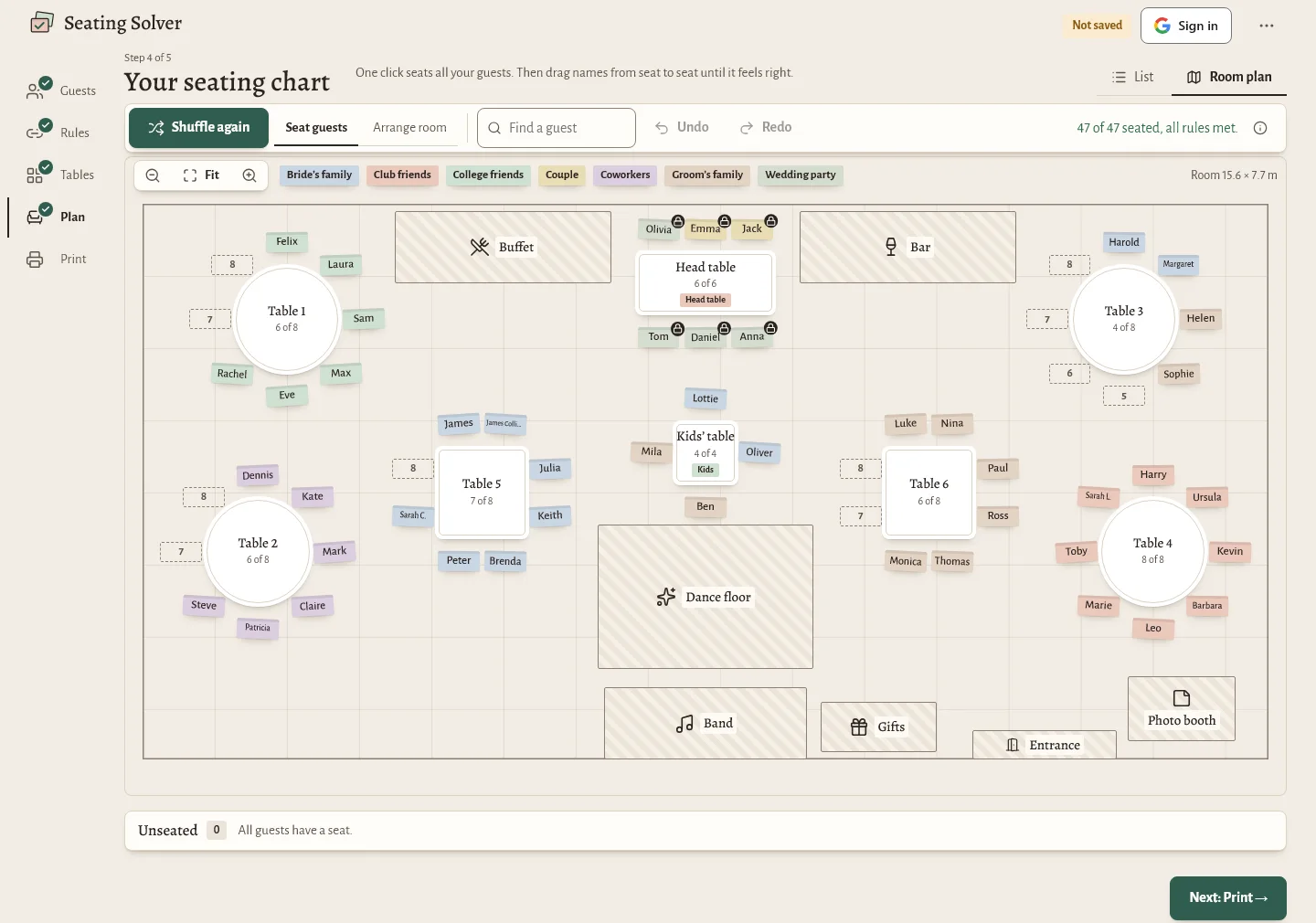
- Open the Tables tab and add your guest tables. For the head table, use Add head table, or add a table with the long, round or square shape and the number of seats you need.
- Add your guests. For anyone who should sit close to the head table, such as grandparents or the parents, open the guest’s Details and choose Near the Head table.
- Seat the people who belong at the head table yourself, by dragging them to a seat or tapping a guest and then a seat, and pin them with the lock. The Head table is only filled with guests you place there; the solver does not put anyone else on it.
- Let the solver seat everyone else. It tries to place guests who asked to be near the Head table as close to it as it can.
- Move tables around on the Plan tab until the room looks right. A sweetheart table is a table with two seats.
Seating Solver does not draw a platform or stage, so tell the venue about that separately. It is free to use and works without an account. For the whole flow, see the guide to making a wedding seating chart, or the seating chart template.
Head table questions
Who sits at the head table at a wedding?
Usually the couple in the middle, with the maid or matron of honor and best man beside them and the rest of the wedding party outwards. Parents often have their own table close by. Practice varies, so adapt it to your families.
What is the difference between a head table and a sweetheart table?
A head table seats the couple with their wedding party. A sweetheart table seats only the two of you.
Do we need a head table?
No. You can use a sweetheart table or sit at a normal guest table. Tell the venue so the toasts and microphone are set up where you sit.
Do spouses and plus-ones sit at the head table?
Often not, since it would make the table very long. They commonly sit together at a table next to it. If you want them at the head table, plan for a longer table or seats on both sides.
Where do the parents sit?
Commonly at their own tables near the head table, sometimes at the head table itself. For divorced parents, give each a table of equal standing.
How long should a head table be?
As a rule of thumb, about 2 feet per person. An 8 ft table seats about four on one side. Ask your venue for exact sizes.
Where should the head table go?
Somewhere the whole room can see it, such as opposite the entrance or at the front of the dance floor. Check sightlines and where the toast givers will stand.
Can Seating Solver plan a head table?
Yes. You add it as a table, seat the people on it yourself, and mark other guests as wanting a seat near it. It is free to use and works without an account.
Plan your head table
Add your tables, place the head table and let the solver seat everyone else.