Christmas place cards, blank (A4)
One A4 sheet with four folded cards, about 100 × 70 mm each, in dark red with a fir tree, with fold line and crop marks.
Blank sheet, A4 (PDF) Blank sheet, US Letter (PDF)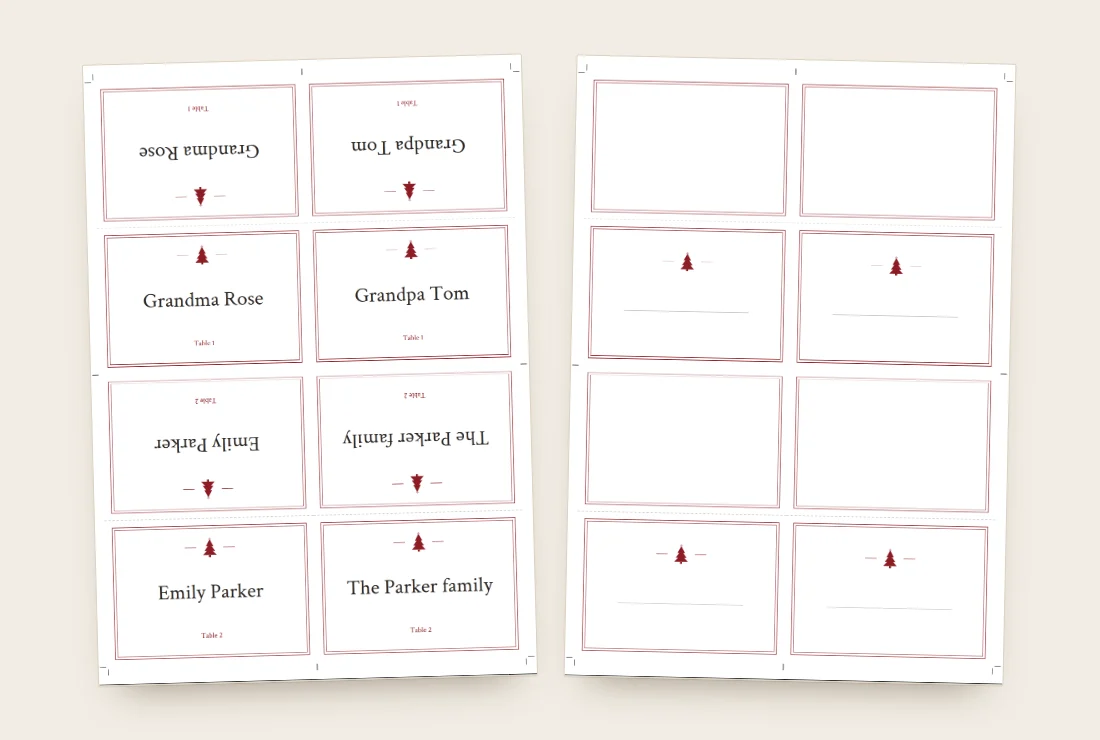
Christmas place cards (also called place names) are small folded cards that tell each guest where to sit. Add your guests to Seating Solver, choose a dark red fir tree design, and print one folded card per person on A4 or US Letter. Or download a free blank sheet and write the names by hand.
Free to use, no account needed. Your guest list stays in your browser.
A place card, or place name, is a small card with one guest’s name that stands at their seat. At Christmas it saves the “where do I sit?” shuffle and lets you plan who sits next to whom. They suit three kinds of occasion:
Eight to fifteen people around one table. Cards avoid the awkward pause and let you seat the grandparents in the middle and the cook near the kitchen.
Three generations, several tables, and a few people who see each other once a year. Cards keep children near their parents and spread out the usual pairings.
Mix teams and put newcomers next to someone they already know. With several tables, the seating plan matters more than the cards themselves.
For a small table, or if you like writing the names with a gold pen: here is the same design without names. It has a fir tree and a line for the name on the front of each card, and the back half is left empty for a short note.
One A4 sheet with four folded cards, about 100 × 70 mm each, in dark red with a fir tree, with fold line and crop marks.
Blank sheet, A4 (PDF) Blank sheet, US Letter (PDF)The simplest cards carry just the name. That is easy to read across a crowded table and never goes wrong. Seating Solver can also print the table number, the meal choice (useful if someone is vegetarian) and the name on the back, so the guest opposite can read it too.
For a personal touch, use the blank sheet and write a line on the back half of each card, such as a thank-you or a small joke. Seating Solver does not print free text or photos on a card.
Classic uses a serif face that suits formal dinners. Modern is a clean sans serif, and Romantic is a script. Short names look best in the script; long names read better in Classic or Modern.
Dark red with a fir tree is the traditional look. Gold with a star feels more formal, navy and sage are quieter. You can also pick any colour you like.
Rest each card against a glass or a bauble, or tuck a sprig of fir, a cinnamon stick or a small sweet in front of it.
With more than a handful of guests, let Seating Solver suggest the plan from your “sits with” and “keep apart” rules, then adjust by hand. The place cards come from the same plan, so the names always match.
Add your guests to Seating Solver, seat them at a table, and open the Print tab. Choose the Classic design, a dark red colour and the fir tree motif, then download the place cards as a PDF. Print on card stock, cut and fold.
Nothing. Place name is the common British term and place card the common American one. Both are the small card with a guest’s name at their seat.
Yes, they are free to use right now. The blank Christmas sheet can be downloaded without an account, and Seating Solver also works without one.
The cards are 100 mm wide and about 70 mm tall folded (3.9 × 2.6 in on US Letter), four to a sheet of A4 or US Letter.
Not through the planner, which prints the name, and optionally the table, the meal and the name on the back. The blank sheet has an empty back half for a handwritten note.
Card stock of roughly 160 to 200 gsm so the cards stand up. Check which weight your printer accepts, or have them printed at a copy shop.